

Think living in your office is hard to pull off? Try paying rent on an overpriced, crappy studio apartment in Los Angeles. Terry K. (not his real name) writes in Salon that he had moved to Los Angeles two years before and was working 60 hours a week at two jobs just to scrape by.
“It had been two years since moving to Los Angeles and, like many Angelinos, I was broke. I stretched the definition of affordability by taking a studio apartment within 20 minutes of work, cramming my belongings into 250 square feet of glorified tenement housing while my savings vanished like a roach in the daylight.”
Terry K. figured he could put the dreams that brought him to L.A. on hold until things got better. Instead, they got worse.
“My identity was stolen. I got a hefty hospital bill for a surgery earlier that year. With existing student loans, a car payment and my rent set for its maximum-allowable annual increase under the California law, I started to wonder: What happened to my American Dream?”
The rent’s too damned high!
In cities across America, many find themselves in the same boat. Wages have stagnated while rents and real estate prices keep skyrocketing. In Los Angeles, the average rent is $1300 per month and a median-priced home is $450,900, according to Business Insider.
Meanwhile, a UCLA study reveals that tenants in Los Angeles pay a whopping 47 percent — nearly half their income — on rent. To make matters worse, Business Insider also points out that people in Los Angeles earn less, on average, than in other expensive cities like New York and San Francisco.
And it’s not just the expensive parts of America where low wages and skyrocketing rents are an issue. USA Today reports there is not a single place in the country where working 40 hours a week at minimum wage would enable you to afford rent on a two-bedroom apartment (the minimum a family of four with a solo breadwinner or a single parent would need).
This map from a report by the National Low Income Housing Coalition shows the situation’s grim. In many states, a minimum wage worker would have to work 80 hours a week or more to afford rent.

Do what one in five U.S. House freshmen do: Live in your office
Things looked gloomy for Terry K., then he realized he had “an ace in the hole.” He came up with the idea of living in his office when he recalled how empty it was at night. “A few months earlier, I stopped by the office on a late-weeknight assignment,” he recalled. “Everything around the place was closed,” he added.
“The land of business plazas was a veritable ghost town, a blank spot on the map, stripped naked from the daytime bustle.”
Terry K. also remembered hearing about how one in five House freshmen chose to live in their D.C. offices to save money and prove they aren’t creatures of Washington.
“They were converting perfectly livable, neglected space into their own white-collar Walden for the working man. I wondered if I could do the same. But before it became necessary, it seemed impossible.”
That’s when Terry K. sublet his apartment, packed up his stuff, got an air mattress and started living in his office. How did he pull it off? He explains that he’d wake up before anyone else came to work, pack up all of his stuff, and turn the lights back on. And then, he’d clear out.
“I’d leave for a morning workout and shower, simultaneously keeping clean and in shape while ensuring I wasn’t always the first to arrive. Occasionally I’d even make myself late to work, blaming the awful L.A. traffic. Just to fit in.”
It sounds like a lot of work, but Terry K. found it much easier than forking over all that money in rent.
“If living in the office seems like too much effort, it was a cakewalk compared to making monthly rent payments.”
Living his best life
While watching his bank account swell, Terry K. gave up the second job and enjoyed having more free time.
“Indeed, what started as a temporary financial solution turned into a lifestyle. I grew to prefer it.”
Meanwhile, all that dreaded debt vanished, his savings grew, and he was able to quit that second job.
“I gave up my apartment entirely, shed a great deal of my belongings, and committed to a life of salaried simplicity.”
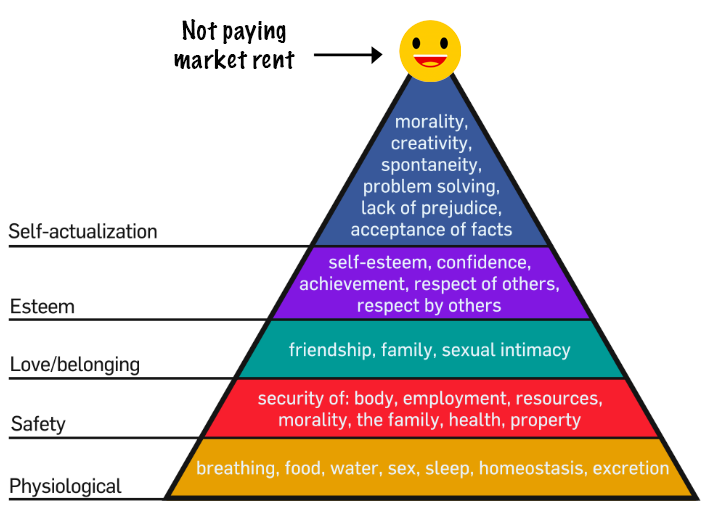
It didn’t take long before he finally had the wherewithal to travel and work on some creative projects. Instead of floundering at “the lowest levels of Maslow’s hierarchy of needs,” he began living his bucket list.
“I took off to the Caribbean for two summer weeks to film a movie. I celebrated New Year’s with a lovely lady in South America. I started reading again. Started writing.”
And how did Terry K.’s boss react to all this increased personal fulfillment? She was thrilled with his job performance. Pleased with how he seemed happier and more focused, she gave him a stellar review.
Terry K. may have set a record
As it turns out, Terry K. isn’t the first to come up with this brilliant money-saving idea of living in the office… Or on the property. Though, at 500 days (71 weeks!), he appears to hold the record.
A thread on Quora reveals Google employees have been doing this for years. After all, Silicon Valley is one of the most expensive housing markets in the world.
Site Ecologist Matthew J. Weaver claims he camped out in the parking lot in an RV for 54 weeks in July 2005-August 2006. “I did it on a dare,” he explains. “It was excellent for my career.” He hosted regular parties and “even had an “astroturf lawn and white picket fence for a while.” But it wasn’t all fun and lawn parties. “The winter was bad, very wet that year… Condensation was a nightmare.” Ben Discoe, a UI programmer chimes in to say he lived in a Conversion Van for 13 months from October 2011 through November 2012.
But an anonymous senior engineer ups the ante. Not only did he live on Google’s Mountain View campus from May 2011-July 2012 (a year and two months), he managed this feat without a vehicle.
” I would consider keeping an RV or other vehicle in the parking lot cheating: I owned no car and slept in nap pods/massage rooms/conference rooms/etc. every night.”
In 2013, the Wall Street Journal even reported that a company called Enplug made a formal arrangement out of this. The Los Angeles-based Advertising and tech company had 12 of their three dozen employees living in a sprawling ranch house in the posh Bel Air neighborhood. Why? So these employees could work without all those annoying “outside distractions” like long commutes and having a life.
“We don’t try to separate work life from our personal life,” 23-year-old CEO Nanxi Liu declared. “It’s a little bit cultish. It is also extremely efficient.”
Rent Another Place? Nah.
After 500 days — over a year-and-a-half — of living in his office, Terry K.’s company went under and he lost his office home. But he still couldn’t bring himself to rent another apartment.
“I realized I valued how I spent my expenses differently. Dropping over a grand every month on a single budget item felt like it ought to result in overwhelming returns. […] What’s more was the sense of entitlement on behalf of many landowners, like I was doing them a favor by handing over 40 percent of my income for a glorified doghouse. The transaction felt oddly imbalanced, a product of seriously misplaced supply and demand.”
Now, Terry K. lives in a truck that he custom-built as a small, portable house.
“I finished building it before I left the office. Everything I needed—a plywood base of shelving housing a tiny fridge, a portable butane stove, a sturdy water jug, a paper towel rack—I was fortunate enough to purchase while money was good.”
Describing his new lifestyle as “Henry David Thoreau meets Henry Ford,” Terry K. writes, does odd jobs, and takes his home with him wherever he goes.
Featured Image: CC by A-SA 2.0 Aaron Jacobs via Flickr.